OFFICIAL ORGANIZATIONAL PROFILE · 2026

Building a connected African workforce for global economic participation.

Global Ready Africa (GRA) is an African youth workforce and economic inclusion initiative connecting skills, proof, networks, infrastructure and access to global economic opportunity.

4Pillars
4Economic pathways
5Hub target
2027–29Programme framework
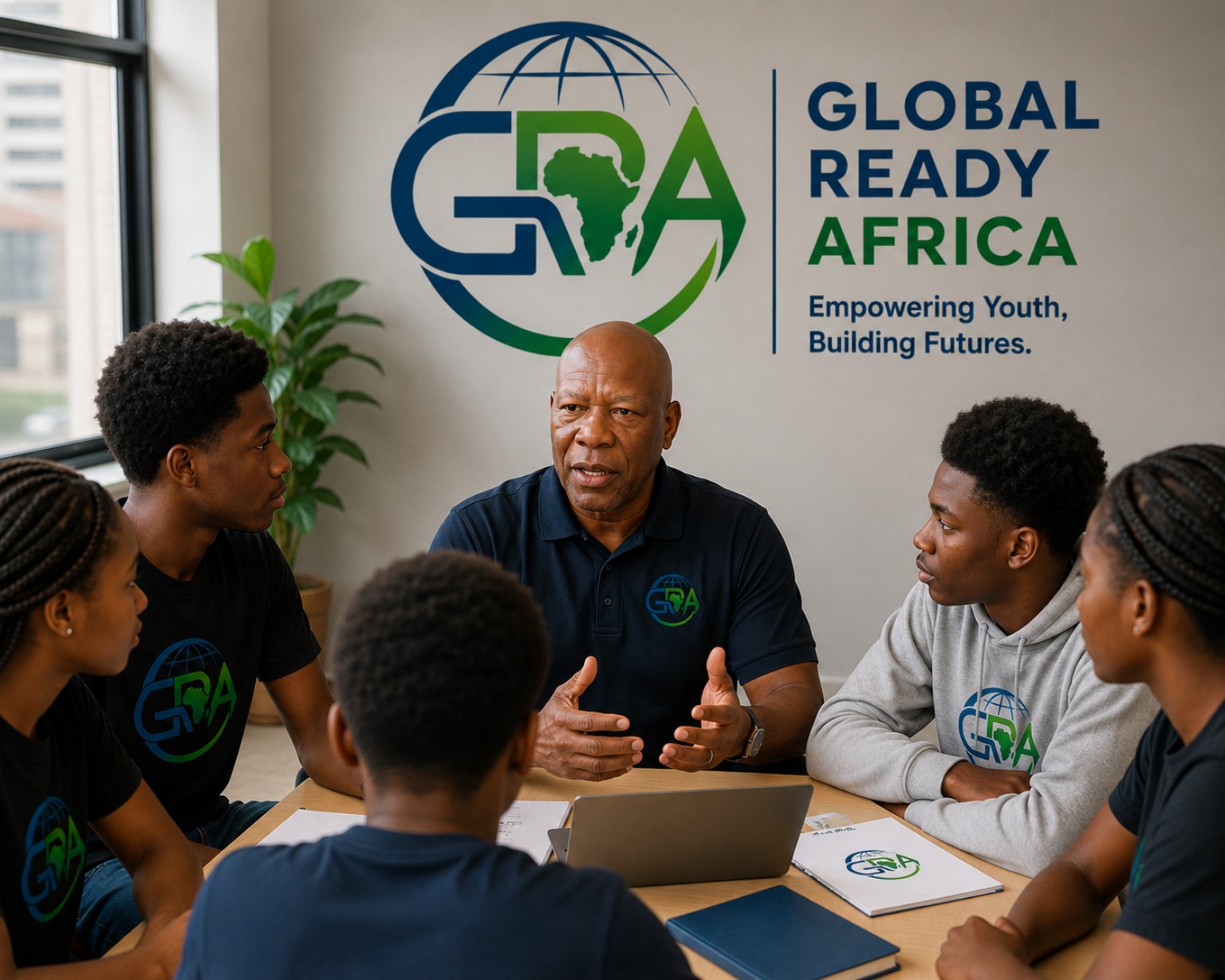
GRA leadership and young people in a collaborative discussion
Leadership · Youth · Digital opportunity
SKILLSCapability
ACCESSOpportunity
Neutral reference edition This profile explains who GRA is, why it exists and how its model works. Programme targets are planning objectives, not guarantees.

ORGANIZATIONAL IDENTITY

Who GRA is

OrganizationGlobal Ready Africa (GRA)
TypeAfrican youth workforce and economic inclusion initiative
Initial basePlot 922 Dangoro Layout, Kumbotso, Kano State, Nigeria
Framework2027–2029
Geographic approachNigeria initially, followed by selected African markets
Core focusSkills · Proof · Networks · Infrastructure · Global opportunity

Global Ready Africa seeks to help build a connected African workforce capable of participating in global economic activity while creating stronger communities and retaining more economic value within Africa.

GRA is designed as an integrated ecosystem that connects capability development with evidence of competence, professional relationships, physical and digital infrastructure, and multiple routes into markets.

“African youth should not have to leave Africa in order to participate in the global economy.”

THE AFRICAN OPPORTUNITY CONTEXT

From connectivity to economic participation

Africa's large youth population creates both an employment challenge and a potential economic asset. Digitalization allows an expanding range of services to be delivered across borders. GRA focuses on the practical connection between African capability and global economic participation.

Connectivity+Skills+Proof+Network+Access→Work→Income
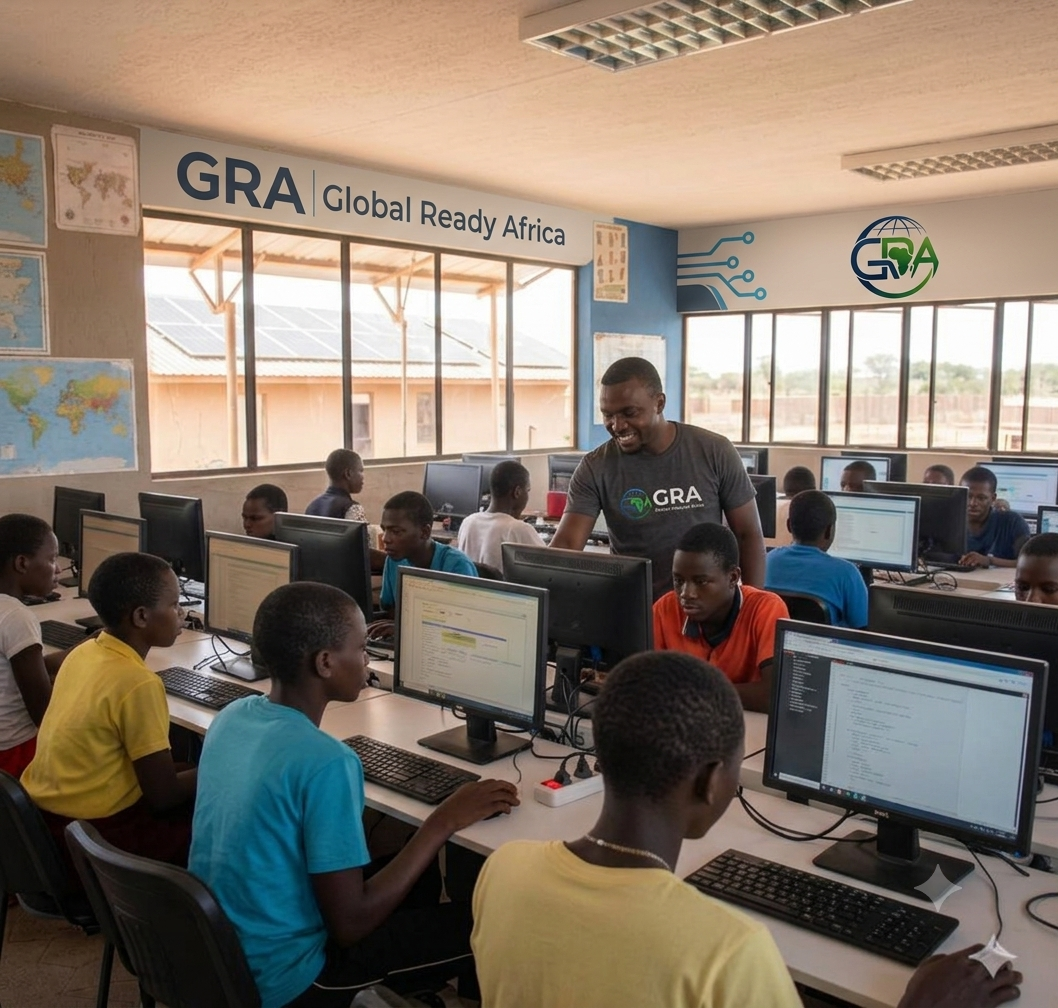
Young people learning and working with computers in a digital classroom
Digital learning · Practical skills · Access
01

Skills mismatch

Training may not closely match current digital work requirements.
02

Credibility deficit

New entrants may lack portfolios, references, credentials or demonstrated work.

03

Network poverty

Young people may have limited access to mentors, clients, employers and professional communities.

04

Infrastructure & access

Power, connectivity, devices, payment channels and market knowledge can affect participation.

INTEGRATED ECOSYSTEM

Five connected components

GLOBAL
ECONOMIC
PARTICIPATION
SKILLSCapability
PROOFEvidence
NETWORKRelationships
ACCESSOpportunity
INFRASTRUCTUREEnabling environment

Skills without proof can be difficult to evaluate. Proof without networks may remain invisible. Networks without infrastructure or market access may not translate into income. GRA treats these elements as an integrated pathway.

THE FOUR PILLARS

Capability → evidence → relationships → opportunity

01
✦

SKILLS

Build practical capability.

Data · virtual assistance · AI tools · UI/UX · digital marketing
02
✓

PROOF

Make competence visible.

Portfolios · projects · certificates · professional profiles
03
◎

NETWORK

Build relationships.

Peers · mentors · practitioners · employers · diaspora
04
↗

ACCESS

Connect capability to opportunity.

Remote work · agency contracts · BPO · mobility · e-commerce

THE FOUR PATHWAYS

Different routes into the global economy

01

Global Remote Jobs

Individual placement

Training and evidence followed by pursuit of remote employment or client work through appropriate market channels.

  • Virtual assistance
  • Data analysis
  • Digital marketing
  • AI-assisted services
02

GRA Studios

Team-based agency

GRA can aggregate trained participants into delivery teams capable of delivering digital services to external clients.

  • Creative services
  • Customer support
  • Data & research
  • Virtual assistance
03

GRA Work Hubs

Physical BPO / digital centres

Shared equipment, connectivity, power, supervision and QA can support digital work where home infrastructure is limited.

  • Data annotation
  • Transcription
  • Research
  • Customer support
04

Global Mobility & E-Commerce

Mobility + entrepreneurship

Education, scholarships or relocation opportunities alongside digital selling of African products, services or content.

  • International education
  • Scholarships
  • Digital products
  • African products & content

PARTICIPANT JOURNEY

A flexible journey, not a single track

01RECRUIT
02ASSESS
03TRAIN
04CERTIFY
05BUILD PROOF
06CONNECT
07MENTOR
08CHOOSE PATHWAY
09WORK / BUSINESS / MOBILITY
10EARN
11ALUMNI

Training is not the endpoint. Economic participation is the intended endpoint.

GRA WORK HUBS

Physical infrastructure for digital work

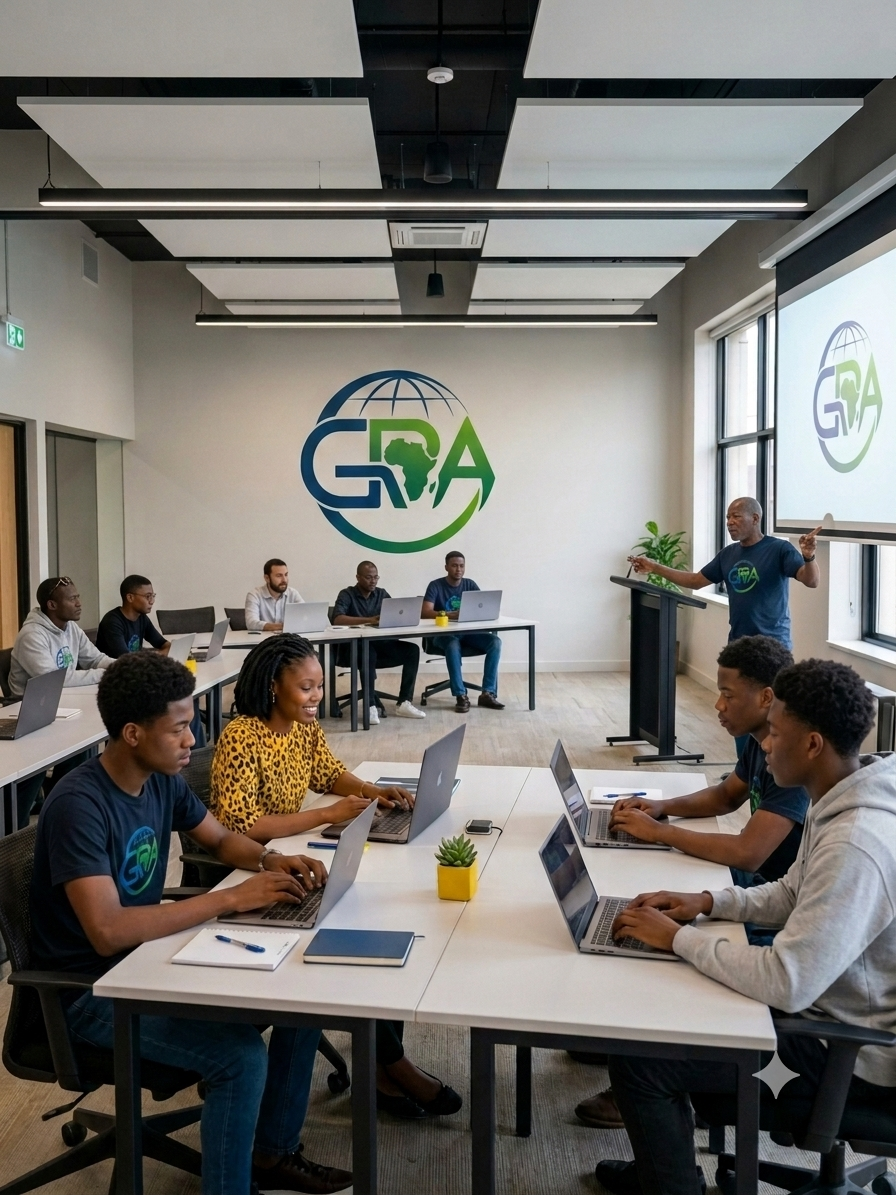
GRA-style digital learning and work environment
GRA WORK HUBLearn · Work · Connect

A GRA Work Hub is a physical environment intended to reduce infrastructure barriers to digital work. Depending on work and partner requirements, a hub may support data annotation, transcription, research, customer support, digital production or other BPO activities.

⚡ Power resilience◉ Reliable connectivity▣ Workstations✓ Quality assurance◌ Safeguarding⌁ Data protection

Typical hub model: TRAINING + WORKSPACE + CONNECTIVITY + POWER + BPO + COMMUNITY

GRA STUDIOS & AI

From trained people to organized delivery capacity

International Client→GRA Studios→Project Team→Quality Assurance→Delivery→Revenue

AI-enabled jobs

Workers use AI to perform traditional digital tasks more efficiently.

AI-specific work

Data annotation, classification, evaluation, human feedback, prompt evaluation, transcription, content review and AI quality assurance.

DIGITAL INCLUSION
Multiple-access participation

GRA-style digital learning and work environment
GRA WORK HUBLearn · Work · Connect

Digital exclusion is not simply a question of whether a person has an internet connection. It can involve device affordability, data affordability, electricity, digital literacy, skills, online safety, payment access and professional knowledge.

PERSONAL
DEVICE
MOBILE
LEARNING
WORK
HUB
COMMUNITYTEAM-BASED
WORK

GEOGRAPHIC SCALE

Nigeria → selected African markets

AFRICA
FOUNDATIONKano State / Nigeria · Pilot and first hub
SCALENigeria · 10,000 cumulative participants targeted by 2028 framework
PAN-AFRICANSelected African countries · 30,000 cumulative participants targeted by 2029 framework
HUB NETWORKSelected cities · 5 hubs targeted

Expansion depends on funding, partnerships, market demand, safeguarding and evidence from preceding phases. Potential expansion markets include Ghana, Kenya, Rwanda, Tanzania, Morocco, and Egypt.

THREE-YEAR FRAMEWORK

Prove → Scale → Institutionalize & Expand

2027FOUNDATION / PILOT1,000 indicative reachPROVE
2028SCALE10,000 indicative reachSCALE
2029PAN-AFRICAN EXPANSION30,000 cumulativeINSTITUTIONALIZE & EXPAND

THEORY OF CHANGE

Reducing the barriers between capability and opportunity

Skills
+
Proof
+
Network
+
Access
→
Global income-generating activity
Higher individual income↓Stronger households↓Stronger local businesses↓More resilient communities↓Greater African participation in the global digital economy

MONITORING & KPIs

Measuring movement from learning to economic outcomes

30,000Youth trained2029 framework
80%Skills pass-rate targetCompetence
20,000Portfolios / verified evidenceWider framework
10,000CertificationsWider framework
10,000MembersCommunity target
500MentorsCommunity target
10,000Youth earning through pathwaysTarget
5Work hubsInfrastructure target
AreaExample indicator
TrainingNumber completing training
ProofPortfolios completed
CertificationCertifications obtained
EmploymentParticipants placed
IncomeIncome generated
Agency / BPOInternational clients, productive work hours and tasks
CommunityActive members and mentor relationships
SustainabilityPercentage of operating costs covered by earned revenue

GOVERNANCE, SAFEGUARDING & SUSTAINABILITY

Responsible participation and institutional development

Governance

  • Clear accountability
  • Documented partner roles
  • Risk monitoring
  • Separation of key responsibilities
  • Evidence-based adaptation

Safeguarding

  • Informed consent
  • Privacy & data protection
  • Safe physical environments
  • Non-discrimination
  • Grievance mechanisms
  • Cybersecurity & ethical AI

Sustainability

  • Employer placement fees
  • B2B hiring fees
  • GRA Studios contracts
  • BPO contracts
  • Training & sponsorship
  • Grants & institutional partnerships
  • E-commerce & digital services

The development funding phase should help establish the infrastructure and systems that eventually generate earned income. GRA's long-term objective is not to create a programme that permanently depends on grants.

COMMUNITY & ALUMNI

Learner → worker → professional → mentor → entrepreneur → employer

Learner → Worker → Professional → Mentor → Entrepreneur → Employer

Over time, alumni can become mentors, trainers, employers, entrepreneurs and community leaders. The aim is to progressively develop an African talent ecosystem rather than continuously import expertise.

INSTITUTIONAL ROLE

Five functions of the GRA model

01

TRAINER

Develops market-relevant digital skills.

02

CREDENTIALING PLATFORM

Helps participants obtain credible evidence of competence.

03

TALENT NETWORK

Connects people with mentors, employers and peers.

04

WORK PLATFORM

Creates direct routes to jobs, agency work and BPO.

05

COMMUNITY INFRASTRUCTURE

Creates physical and digital spaces where young people can learn, work and collaborate.

DEVELOPMENT ALIGNMENT

Broad alignment with the Sustainable Development Goals

SDG 1No PovertyIncome generation & inclusion
SDG 4Quality EducationPractical digital skills
SDG 5Gender EqualityInclusive access
SDG 8Decent WorkEmployment & entrepreneurship
SDG 9Innovation & InfrastructureTechnology-enabled activity
SDG 10Reduced InequalitiesAccess for underserved populations

LONG-TERM VISION

An African network of digital economic communities

People+Skills+Technology+Infrastructure+Employers+Capital+Markets

The ultimate objective is not simply to produce more freelancers. It is to help build an African workforce that can work globally, build globally, sell globally, collaborate globally, earn globally, invest locally and create jobs locally.

CONTACT & REFERENCE

Global Ready Africa (GRA)

Building a Connected African Workforce for Global Digital Economy.

AddressPlot 922 Dangoro Layout, Kano State, Nigeria Telephone+2348131847777 Email 1gwanisoft.office@gmail.comEmail 2info@gwanisoft.com Websitewww.gra.gwanisoft.com

Reference note: Programme targets and model descriptions are drawn from the GRA project framework. External statistics should be separately sourced and dated when this document is used for formal institutional reporting.